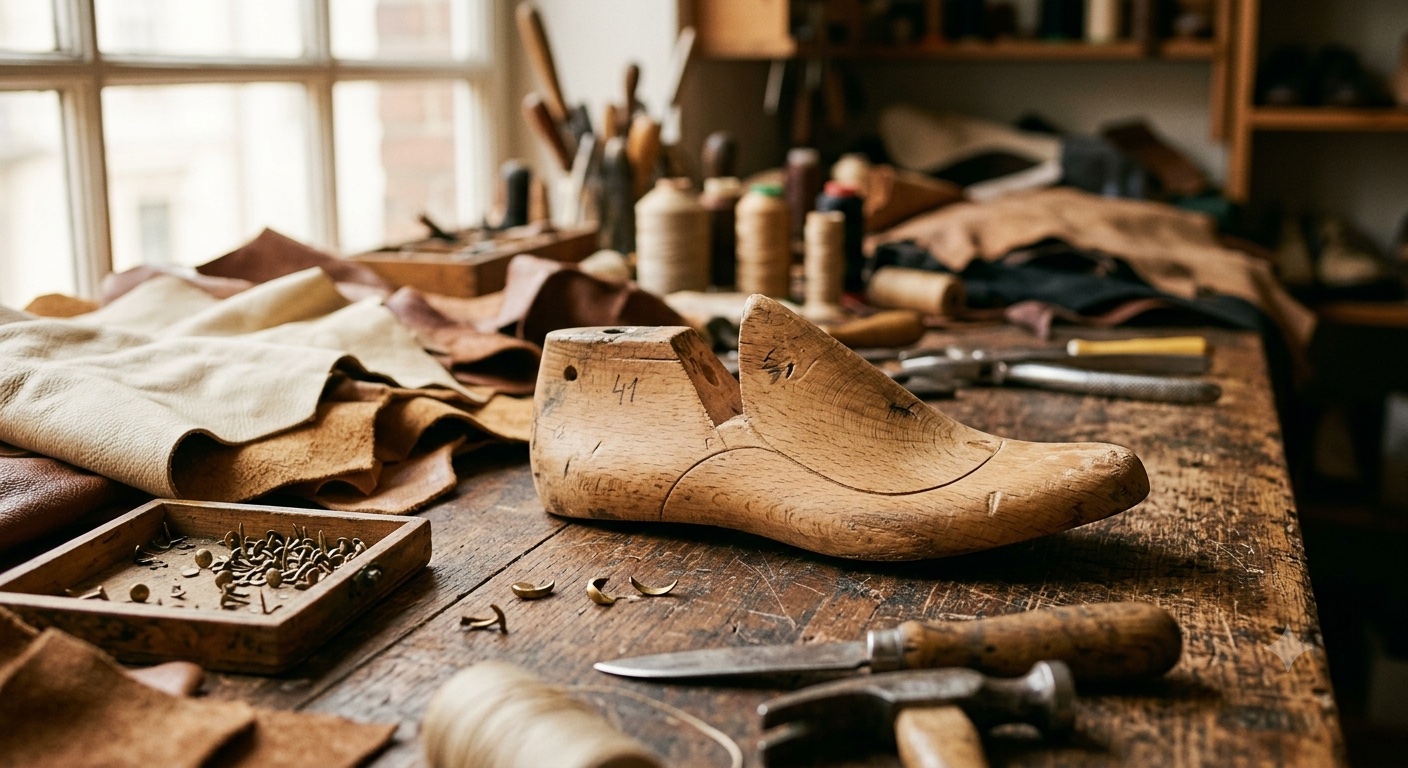
The last · carved beech · the form every Patina shoe is built around
A glued shoe is finished when it leaves the factory. A welted shoe is built so a cobbler can open it, replace the sole, and close it again — for as many decades as the upper survives. Here is how that shoe is made.
A shoe is built around a last — a carved wooden foot-form that fixes its shape and fit. Ours are graded across fourteen sizes and kept, not discarded, so a shoe sent back years later can be rebuilt on the exact form it was born on.
The upper is cut from the hide by hand. The cutter "clicks" the knife around the pattern, reading the grain — the tightest, most even leather goes on the toe and vamp, where the eye lands and the flex is hardest. The offcuts tell you how good the cutter is.
The cut pieces are stitched into an upper — seams, eyelet facing, and on the brogue, the punched broguing. The thread is waxed by hand; the stitch count is held to the inch. A closer's seam should be invisible from a step away and flawless from an inch.
This is the one that matters. The upper, insole, and a strip of leather called the welt are stitched together; then the outsole is stitched to the welt — never glued to the shoe. That single construction choice is what lets the sole be cut off and replaced without touching the upper. It is the whole reason a Patina shoe outlives the box.
Burnished by hand, thin layer over thin layer, until the toe holds a deep oxblood mirror. This first patina is the only one we give you. Every one after — the scuffs, the darkening, the shine your own polishing builds — is yours to make.